How AI is changing investment banking
BankingBy Faraaz Khan
Until a year or two ago, “AI in banking” mostly meant a chatbot in a retail app or a credit-scoring model. Neither did much for an M&A team. Now the same models people use to write code can read a whole data room, work out a storyline, and hand back something that looks a lot like an analyst’s first draft.
This post is our view of what’s actually changing, where it shows up in the day-to-day work of a deal team, and what stays exactly the same.
What changed in the technology
Three improvements matter most for banking.
- Long reading. Models can now take in hundreds of pages at once: audited financials, a quality of earnings report, a management presentation and a market study, all in one go.
- Planning and tool use. Instead of answering one question, an AI agent can plan a multi-step job, open files, run calculations, build a chart, look at the result, and fix what’s wrong.
- Structured output. The output no longer has to be a paragraph. An agent can produce a slide, a table or a working spreadsheet, laid out to a specific style.
So you can give an agent a brief and a folder of files and get back a real first draft: a CIM, a pitch book, a model.
Where it helps on a live deal
Diligence and research
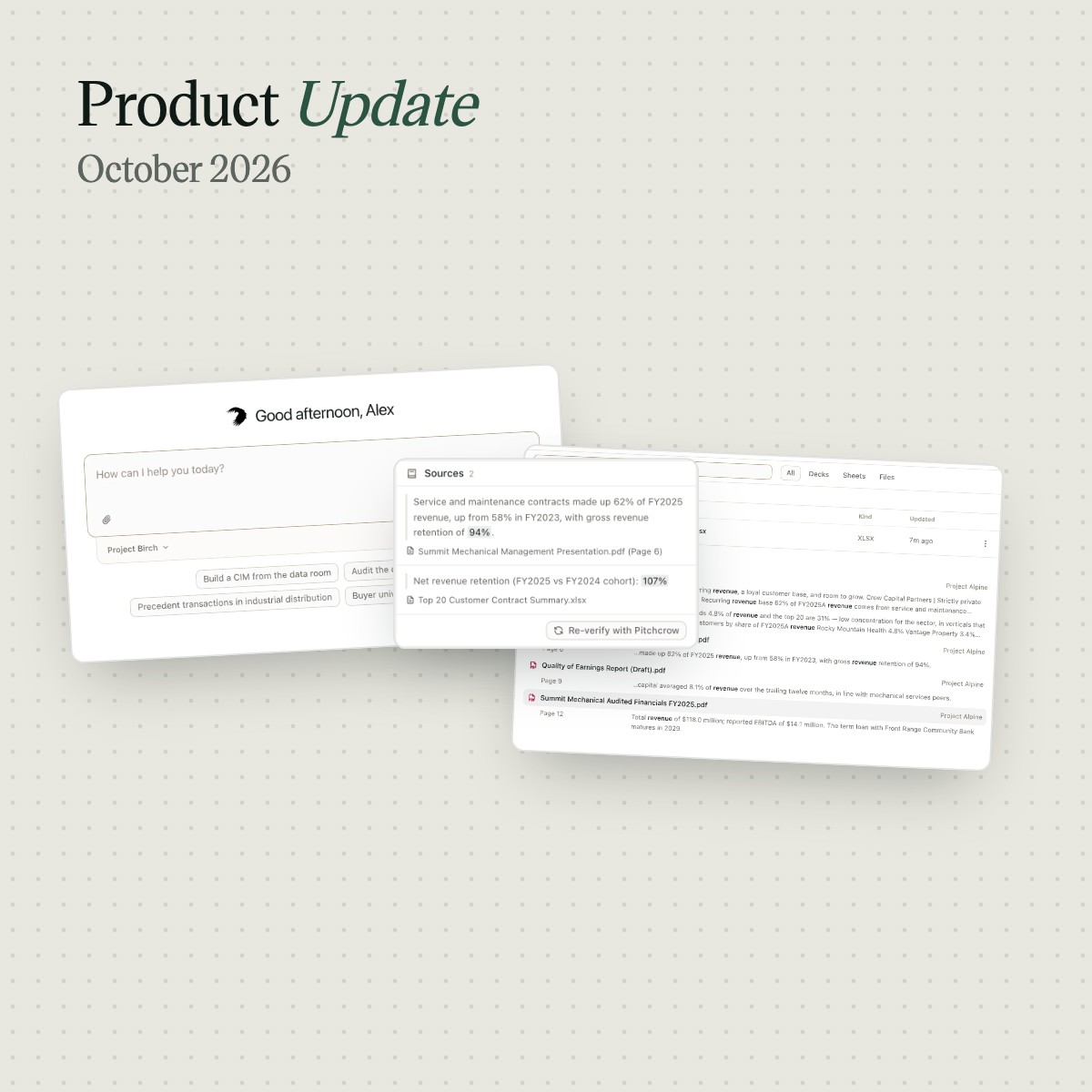
The first days of a mandate are spent reading. AI turns the data room into something you can question: “what was FY2025 gross margin?”, “which customers are on multi-year contracts?”, “where does the QoE adjust EBITDA?”. The answer comes back with the page it came from, so it can be checked.
In Pitchcrow, each deal gets a space that holds its data room. Ask a question and the agent picks the right files, reads them, and answers with the pages it used. Search works the same way. Type “EBITDA” and you get the QoE page, the cell in the model and the CIM slide in one list, and each one opens right where the match is.

Drafting
Pitch books, CIMs, teasers and lender presentations follow patterns a firm has repeated hundreds of times. That makes them a good fit for AI. The agent learns the structure and house style from the firm’s own past decks, and builds the first draft. The team starts from a complete document instead of a blank template.
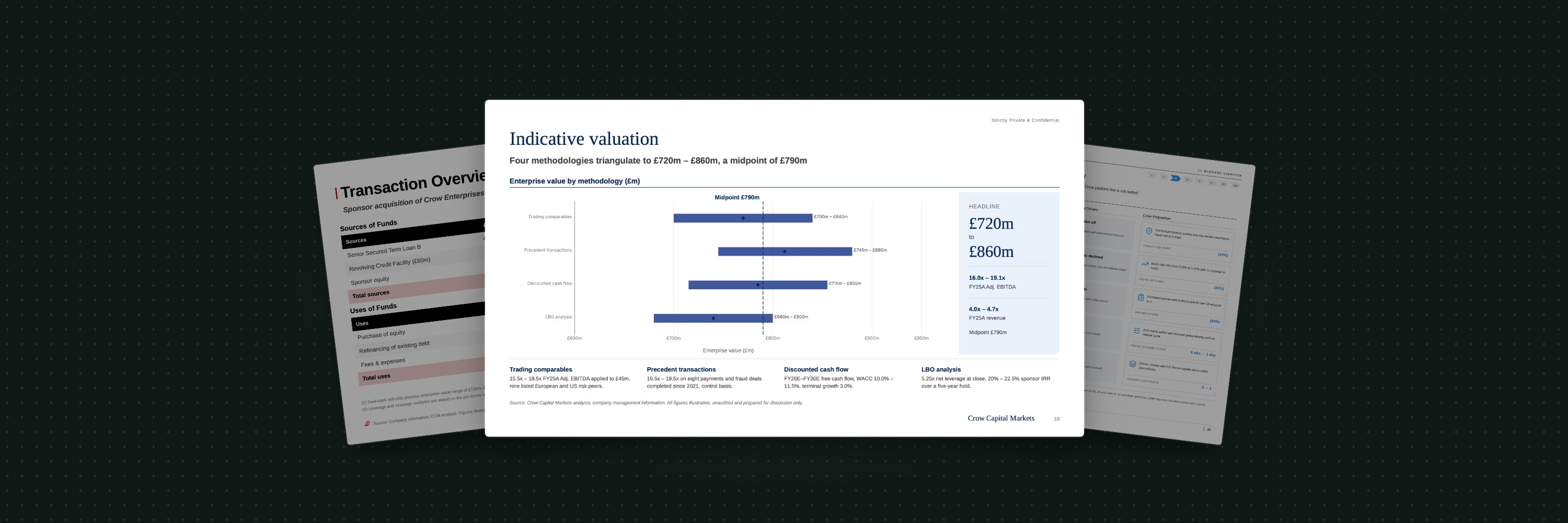
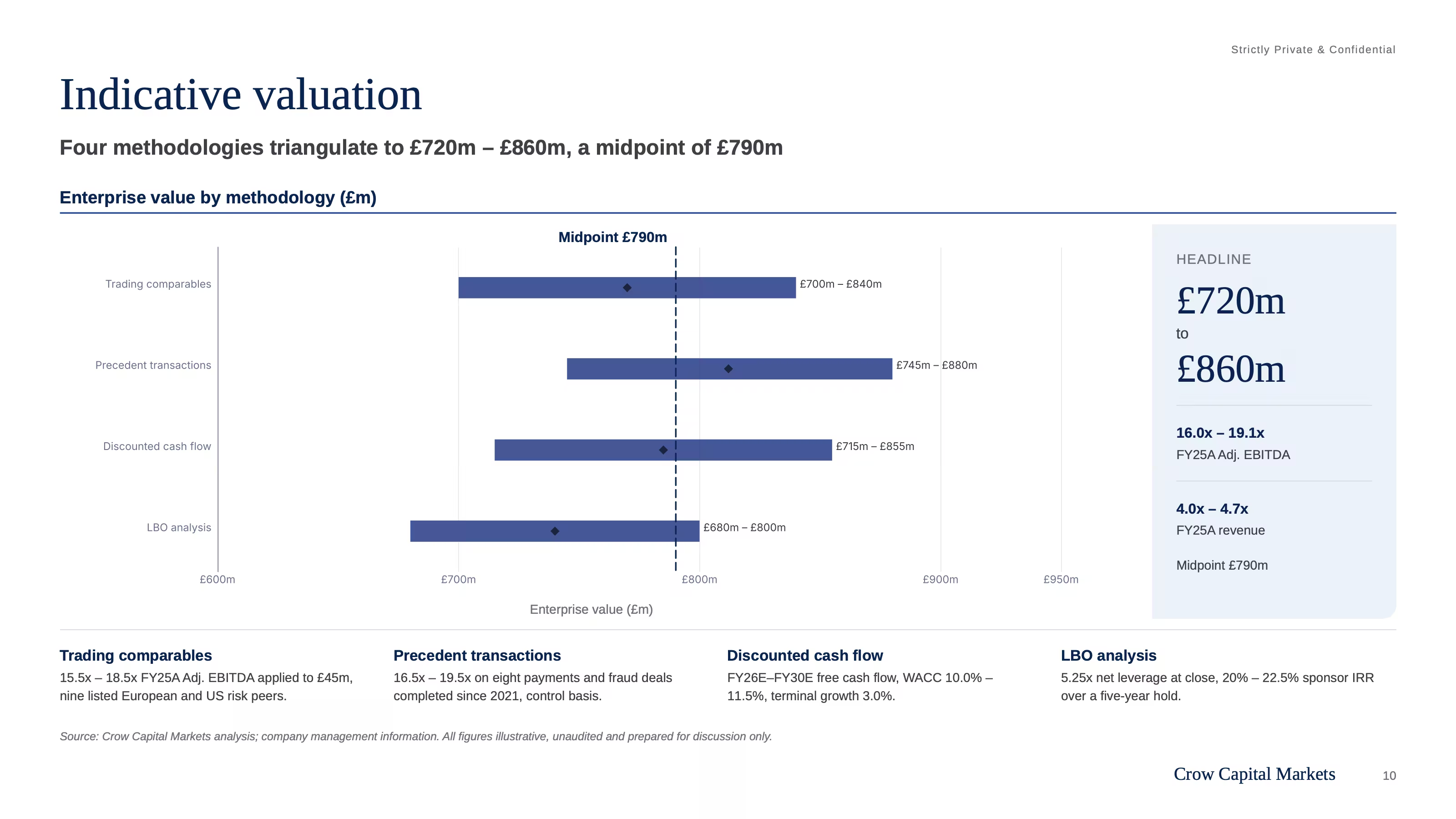
That’s why Pitchcrow learns from a firm’s own work. Brief it the way you would brief an associate, and it picks the closest of your reference decks before it plans, then follows its layouts, fonts, colors, headers and footers. It builds every page, with charts, tables and football fields, while you watch and redirect it.
Modeling
Models are where trust matters most. AI can lay out a three-statement projection, comps, a DCF or an LBO to banking convention, but every input still has to tie to a source. The useful version of this is a model where each number links back to the file it came from, so a reviewer can check it in one click.
Pitchcrow builds the model in the same workspace as the deck, laid out tab by tab the way a desk would. Charts in the deck stay linked to the model, so when an assumption changes, the pages that use it can change with it.
Review
Review is a loop: a senior marks up the draft, a junior makes the changes, repeat. AI shortens each turn. Comments can be handed straight to the agent, and the changes come back in minutes rather than the next morning.
With Pitchcrow, seniors comment right on a slide or a range of cells, and each comment stays pinned to that spot. The team can hand the open comments to the agent to work through, publish a fixed version for reviewers while editing continues, and go back to any earlier version from the history.
What doesn’t change
AI makes the first draft faster. It doesn’t do the parts of the job clients actually pay for.
- Judgement. Which buyers to call, how to handle a weak quarter, where to anchor on price. Someone has to make those calls, and it shouldn’t be software.
- Relationships. Mandates are still won on the phone and in the room, by an MD the client trusts.
- Accountability. The bank’s name is on every page, so a person still reads it and signs off.
What firms should watch for
The risks are real, and they are specific to this industry.
Numbers without sources
The failure that worries us most isn’t clunky writing. It’s a revenue figure from the wrong year that reads perfectly well. In a CIM, that’s the kind of mistake a buyer finds. So if you can’t click a number and see where it came from, we don’t think you should trust it.
We spent more time on this than anything else. Every figure Pitchcrow takes from a file or the web is saved with its source, whether a page in a PDF, a range in a model or a web page, along with the exact quote. Anything it can’t back up, like a placeholder, is marked Illustrative so it’s easy to find. Turn on Show sources to see them on the slide, filter the Sources tab to anything unverified or illustrative, and ask the agent to re-check a number in one click.

Confidential information
Everything in a data room is material, non-public information. Pasting it into a consumer chatbot isn’t an option. Firms need to know where their data goes, who can see it, whether it is used to train models, and how the AI itself is kept apart from other clients’ data.
We designed Pitchcrow with this in mind from day one. Each deal gets its own space, and only the people you add can open it. When the agent works, it runs on a throwaway machine with no passwords on it. Every time it asks for a file, our server checks that the person is on that deal. If they aren’t, the agent gets nothing back. Your files aren’t used to train AI models, and the audit log shows who viewed, edited or exported what. Our security page has the details.
Decks that look like everyone else’s
If the draft doesn’t look like your firm’s work, someone has to rebuild it page by page, and most of the time you saved is gone.
So Pitchcrow starts from your own decks. Add a few recent pitch books and CIMs, and it picks the closest one and copies how your firm does things: the title bar, the footer, how much goes on a page. You can still move any box yourself. The editor works like PowerPoint and Excel, so the shortcuts your analysts already use just work.
What changes for analysts, VPs and MDs
If the first draft shows up the same afternoon instead of after a weekend, everyone’s week looks different.
- Analysts become editors. They write the brief, review what comes back, check the numbers and push the storyline further. It takes more judgement, not less.
- VPs see drafts earlier. Review moves from Thursday to Monday afternoon, while there’s still time to change the story.
- MDs review from anywhere. A draft can be paged through on a phone between meetings, with changes dictated straight back to the agent.
- More pitches go out. A lot of pitches never get made because no one has the nights to build them. With the build mostly done for you, the same team can take more of those shots.
Banking is still about people. What AI takes away is the formatting and checking that never needed a banker. What’s left is the work most people joined a bank to do. If you want to see it on one of your own deals, schedule a demo.